
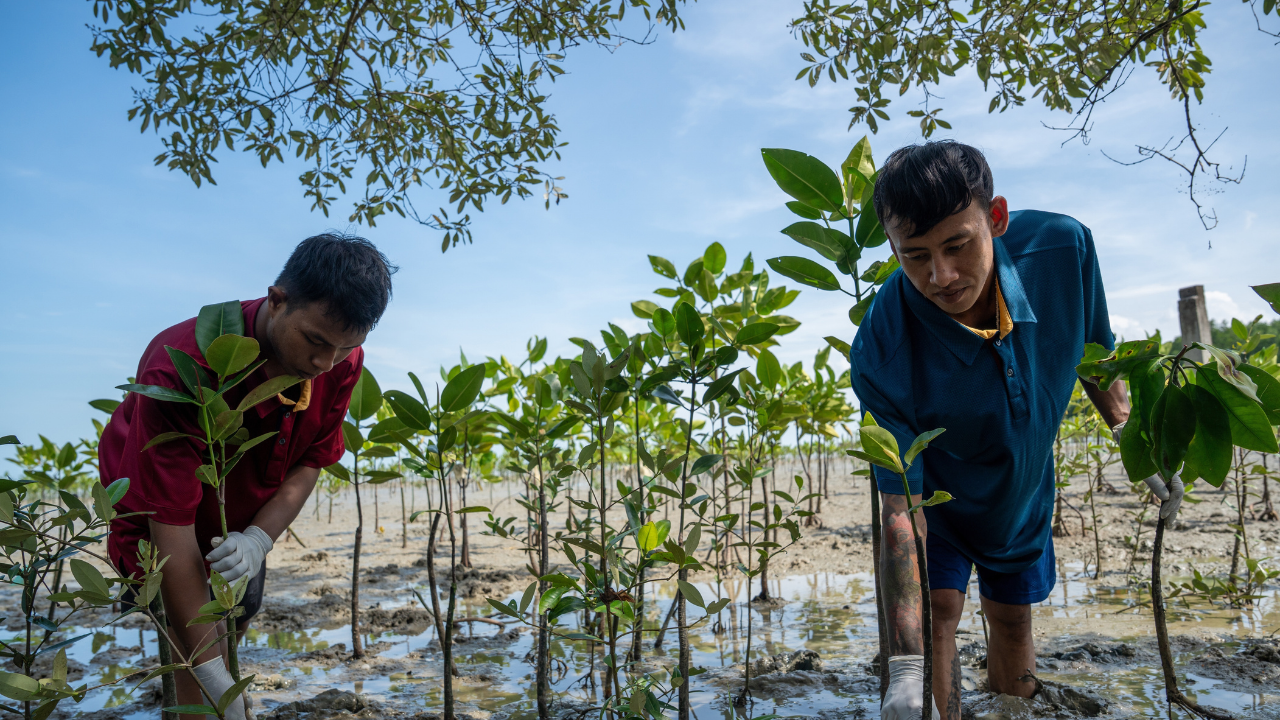
Government interest in blue carbon is growing as countries look to protect and restore coastal ecosystems while advancing climate, biodiversity and resilience goals. But creating the right conditions for a thriving blue carbon sector takes much more than simply getting a carbon market framework in place. Five policy choices are particularly important.
Blue carbon is attracting growing attention from governments, but turning policy intent into the practical conditions that allow projects to move forward is rarely straightforward.
Part of the challenge is structural. Blue carbon projects sit at the intersection of several policy and governance areas, including coastal and marine management, land tenure, climate policy, and community rights. These can involve different agencies, rules and decision-making processes that need to work together.
At the same time, governments are responding to a fast-evolving carbon market, with new questions around Article 6, carbon rights and international credit transfers adding another layer of complexity.
So where should policymakers focus first? Drawing on Fair Carbon’s analysis of blue carbon enabling conditions across multiple countries, five priorities stand out.
The starting point is not the carbon market. It is what a country wants blue carbon to deliver.
Coastal ecosystems can contribute to climate mitigation and adaptation, biodiversity, coastal protection, fisheries and livelihoods. Blue carbon policy therefore needs to connect with wider national priorities rather than developing as a separate carbon-market track.
That means asking where blue carbon fits within Nationally Determined Contributions (NDCs), national adaptation and biodiversity strategies, ocean and coastal policies, and plans for mobilizing climate and nature finance. It also means considering whether carbon finance is the primary objective or just one source of finance within a broader strategy to protect and restore coastal ecosystems.
Getting that alignment right can influence decisions further down the line. It can help governments decide which projects to encourage, where public or blended finance can complement carbon revenues, how international transfers fit with domestic climate goals, and which ministries need to be involved.
The practical lesson is to establish those priorities early. Otherwise, governments risk making project and carbon market decisions without a clear view of how they contribute to broader national objectives.
Blue carbon rarely fits neatly within a single government mandate. Mangroves and other coastal ecosystems lie at the intersection of land and sea, so responsibility can be spread across climate, environment, forestry, fisheries, land, coastal management and finance authorities.
The challenge is not necessarily the number of institutions involved, but whether their responsibilities and decision sequence are clear.
Where mandates overlap, developers can receive conflicting guidance, repeat consultations or spend months establishing which institution has the authority to make a particular decision. The same fragmentation can make it harder for governments themselves to maintain consistent oversight.
A useful first step is to map the project pathway through government: which institution becomes involved, at what stage, what decision it makes and how that connects with the next approval. This can expose duplicated requirements, gaps in responsibility and points where coordination is needed.
Governments can then decide whether a lead institution, formal inter-agency process or clearer published guidance would make the system work better. The aim is not to remove safeguards or centralize every decision, but to make the route sufficiently predictable for projects to understand what is expected of them.
Nigeria offers one example of progress in this direction. Its Climate Change Act, carbon market framework and 2025 Manual of Procedures have given developers greater visibility over the steps required for government approval and registration. But Fair Carbon’s analysis also found that projects may still need approvals from several agencies, and that land and forestry processes vary by state, showing why a carbon market procedure alone does not resolve every bottleneck.
Even a clear approval pathway cannot answer a more fundamental question: who actually has the right to undertake the project and benefit from the carbon?
Coastal landscapes can involve overlapping statutory tenure, customary rights, community use, public ownership, concessions and protected-area designations. Carbon rights may not automatically follow land or resource rights, and in some jurisdictions they may not yet be defined explicitly at all.
Governments therefore need to understand how their existing legal frameworks apply before projects reach an advanced stage. Who can authorize an activity on the land or water? Who can claim or transfer the resulting carbon credits? What happens where customary and statutory rights overlap? And who is entitled to receive project benefits?
This is also where community safeguards need to be considered as part of the policy architecture rather than added towards the end of project development. Free, Prior and Informed Consent (FPIC), where applicable, meaningful participation and credible benefit-sharing arrangements all depend on understanding who holds rights and how affected communities will be involved.
There is no single model governments need to adopt. In some cases, the priority may be explicit legislation on carbon rights. In others, clearer guidance on how existing land, resource and customary rights apply may be sufficient. What matters is that projects, communities and investors can establish the answer without having to interpret legal ambiguity for themselves.
For governments, leaving these questions unresolved can create legal, social and reputational risk, as well as delay projects. Addressing rights, participation and benefit sharing early can reduce the likelihood of later disputes and strengthen public confidence in how blue carbon projects are governed.
Fair Carbon’s country analysis shows why this matters. Countries with relatively developed carbon market architecture can still have unresolved questions around ownership and carbon rights, while more prescriptive benefit-sharing rules can create different trade-offs around certainty, flexibility and project viability. These are choices that need to be made deliberately rather than emerging project by project.
For countries choosing to use carbon finance, governments need to decide not only whether projects can generate credits but how those credits can be used.
Projects may operate in voluntary carbon markets, seek authorization under Article 6 of the Paris Agreement, participate in domestic compliance mechanisms or potentially move between different routes over time. Each option raises questions about eligibility, authorization, registries, transfers and national carbon accounting.
For policymakers, there is a balance to strike. Projects and buyers need enough certainty to make long-term decisions, while governments need to retain control over how mitigation outcomes are used, how international transfers are accounted for and how those decisions affect progress towards the country’s own NDC.
That makes transparency around the decision-making process particularly important. Governments can clarify which project types are eligible, whether and under what circumstances they will grant authorization, who makes that decision, how they will treat corresponding adjustments, and what information they will record publicly.
The objective is not necessarily to finalize every possible market rule before projects begin. Carbon market implementation will continue to evolve. But developers and buyers need to understand the decision points, the rules currently in force and how future decisions will be made.
Policy quality is only part of the equation. Governments also need the institutional capacity and shared understanding to make confident, coordinated decisions as projects move from proposal to implementation.
That includes technical expertise in carbon accounting, monitoring, reporting and verification, but it goes considerably further. Officials need to understand how project development, carbon markets, legal rights, safeguards and national climate accounting interact. Different agencies also need enough shared understanding to make coordinated decisions.
Where that capacity is uneven, even relatively clear regulations can become difficult to implement. Approvals can slow down, institutions may interpret requirements differently and uncertainty within government can lead to cautious or fragmented decision-making.
The answer is not simply more technical training. Governments need practical opportunities to work through real decision-making scenarios: mapping an approval pathway, considering the consequences of different authorization choices, identifying conflicts between agencies or testing how a proposed approach to carbon rights and benefit sharing would work for an actual project.
Fair Carbon’s work with governments is increasingly focused on this applied approach: combining comparative policy evidence with diagnostics, case studies, peer learning and practical exercises that help officials identify where their own systems are working and where changes are needed. The aim is to build the capability to make informed decisions, rather than prescribe a single policy model.
The common thread across these five priorities is that no single policy can create a strong enabling environment on its own.
A country can have clear carbon-market rules but unresolved carbon rights. It can establish an approval process while leaving mandates fragmented across institutions. Strong technical capacity cannot compensate for weak community safeguards, just as an Article 6 framework will not resolve uncertainty over tenure.
The more useful question for policymakers is therefore not simply “Do we have the right policies?” but “Can a credible project actually navigate this system from start to finish?”
Answering that requires looking across the project lifecycle: mapping the decisions a project encounters, identifying who owns them, testing where uncertainty or duplication remains and deciding which changes would make the greatest practical difference.
Fair Carbon’s Enabling Conditions Country Profiles and Global Policy Briefing provide comparative analysis of how countries are tackling these questions and where gaps remain. The 2026 Global Policy Briefing, due later this year, will extend that analysis and draw out further lessons from different national approaches.
The next step is to turn that evidence into action. Fair Carbon is developing practical capacity-building support to help policymakers and technical officials assess their enabling environment, map approval and authorization pathways, work through policy trade-offs and identify the reforms and coordination measures that can make the greatest practical difference.
Countries will arrive at different answers. The purpose is not to create a single blueprint for blue carbon policy, but to help governments make those choices deliberately, understand their consequences and create a clearer route from national ambition to high-integrity projects on the ground.